Introduction
Artificial intelligence is transforming agriculture – now in 3D. While many AI applications have traditionally relied on 2D data such as satellite imagery, 3D point cloud classification is rapidly gaining attention. This technology opens up entirely new possibilities for capturing and analysing agricultural structures with remarkable precision. Thanks to modern drones, scanners, and mobile devices, creating 3D scans is now easier and more cost-effective than ever, significantly advancing their use in agronomy.
One particularly exciting application is the quantification of biomass – a key metric for growth, yield, and plant health. With rising demands for sustainability, resource efficiency, and climate resilience, 3D analysis offers farmers a major leap forward in innovation.
Several years ago, we developed a platform for analysing 3D point clouds, which has since become a market leader. Pointly enables efficient processing of point clouds and extraction of valuable insights. We are now combining our deep expertise in agriculture and plant science with the world of 3D technology to expand our offering.
Digital Twins in Agriculture
A digital twin is an exact virtual representation of a real-world object – in this case, a tree or plant. By combining 3D scans, multispectral data, and machine learning, each plant can be captured, analysed, and monitored with high accuracy.
What makes this approach unique is that a digital twin goes beyond simple visual representation. It integrates multiple data sources such as weather conditions, soil properties, or spraying protocols to create a comprehensive picture of a plant's health and growth. This fusion of data enables precise biomass calculations and supports data-driven optimisation of agricultural processes.
Use Case: Biomass Quantification in Fruit Trees
A concrete example of 3D object classification in practice is the quantification of biomass in fruit trees. This method delivers detailed insights into plant growth by capturing and analysing structural components like branches, leaves, and fruits separately.
Capturing the Tree as a Digital Twin
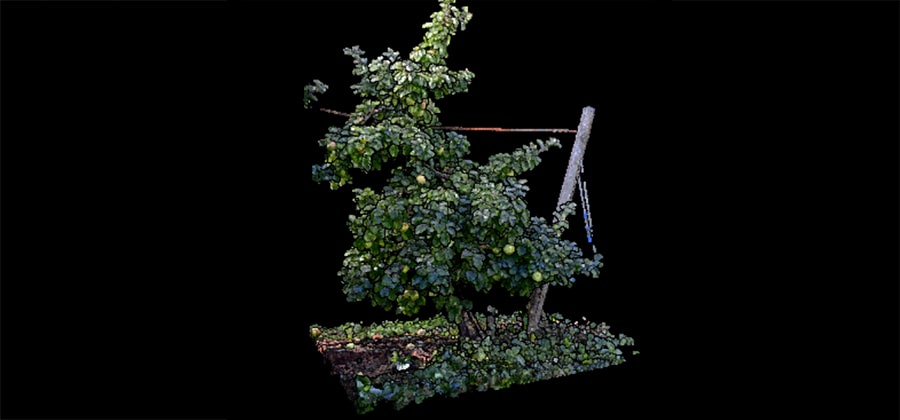
Using drones, LiDAR scanners, or multispectral cameras, a complete 3D model of a fruit tree can be created. This model contains a high-resolution point cloud that accurately represents the tree's structure, forming the basis for automated classification.
Structural Classification and Analysis
Artificial intelligence can be used to precisely classify various components of a tree:
- Branches and canopy – for determining wood mass and structural stability
- Leaves – to calculate leaf area, an indicator of photosynthetic activity
- Fruits – for quantifying fruit mass and improving harvest forecasts
Based on these structural features, the total biomass of a tree can be estimated. The data can also be combined with historical growth records to generate predictive models for yield optimisation.
Integration with additional data sources
Pure 3D capture, however, is only one part of the analysis. Combining it with weather, soil, and irrigation data yields even more precise insights:
- Satellite and drone data complement the 3D models with NDVI analyses to determine plant health.
- Weather and climate data feed into forecasting models and help detect stress-related changes in growth.
- Spraying and fertilisation protocols are reconciled with the biomass analysis to enable efficiency gains in fertilisation and crop protection.
Benefits of 3D object classification for farmers
Using digital twins and 3D object classification offers numerous benefits for agriculture:
- More efficient spray application: pinpoint determination of biomass can enable targeted and reduced use of sprays, lowering costs and environmental impact.
- Yield prediction: precise quantification of plant components allows more accurate yield forecasts.
- Optimised resource use: fertilisation and irrigation can be matched to the actual needs of the plant, lowering costs and minimising environmental impact.
- Automated monitoring: regular scans allow plant growth to be documented continuously and compared with historical data.
- Early problem detection: diseases or nutrient deficiencies can be identified early and treated in a targeted way.
This level of precision enables growers to make informed decisions about irrigation, fertilisation, and harvest timing – reducing waste and maximising yield while supporting sustainable farming practices.