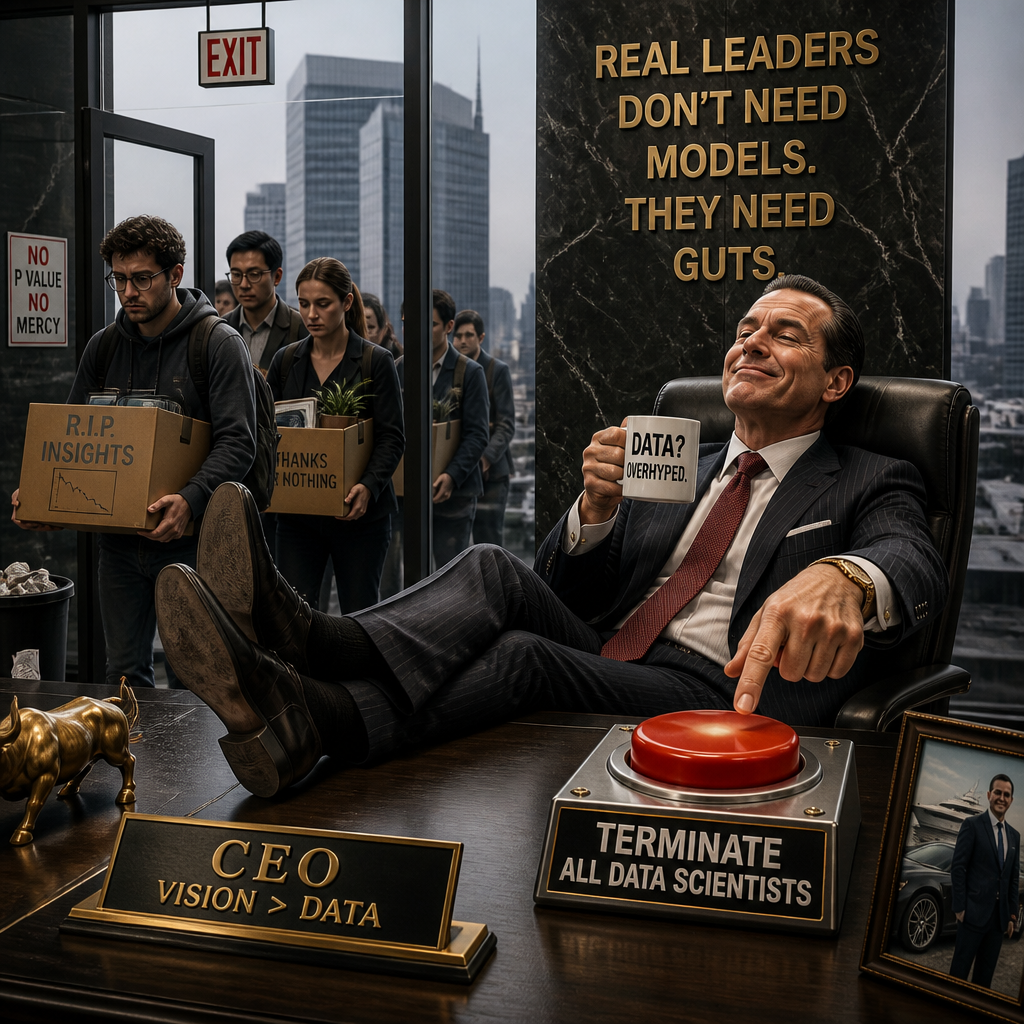
You know the promise. It goes something like this:
As a CEO, I can now do it all myself. I don't need data engineers, data scientists, software developers or backend people anymore. Copilot, Claude and the rest solve it for me – no domain knowledge required. One prompt, one result, done.
I took that claim seriously. Not on a slide – in practice. And I'm writing this because the outcome surprised me more than I expected, in both directions.
What modern LLMs actually deliver (and it's a lot)
Let's start with what's true. Because it would be dishonest to trash the hype – we build AI products, and we see the impact every single day.
Large language models are the biggest productivity jump I've seen in 14 years of data science. Concretely:
- Boilerplate, glue code, test scaffolding, data scripts – things that used to eat hours now take minutes.
- Prototyping has become radically cheaper. An idea turns into a working demo overnight, instead of over two sprints.
- Documentation, code reviews, refactoring, understanding an unfamiliar codebase – all faster and less painful.
- Exploratory analysis, first model baselines, thinking through architectures – the AI is an excellent sparring partner.
A good developer or data scientist isn't 10% faster with these tools. They're several times faster. That's real, it's enormous, and whoever ignores it loses.
But – and here comes the part that's missing from the keynote stages.
The reality check
When I tried to reach a production-ready result on my own, with AI instead of my team, here's what happened:
The model was convincing – and wrong. An LLM phrases nonsense in exactly the same confident tone as a correct analysis. There's no red border around a hallucination. Without someone who has the expertise – agronomy, remote sensing, biostatistics, machine data – nobody in the room notices that the beautiful result points in the wrong direction. That's not "no result." It's worse: a wrong result that looks like the truth.
The demo doesn't scale. The prototype ran on a laptop. In production – with real satellite imagery, noisy sensor data, 3D point clouds, missing values, latency requirements and three dozen edge cases – the house of cards collapses. The last 20% (data engineering, MLOps, monitoring, reproducibility, scaling) is 80% of the actual work. And that's exactly what a prompt can't shortcut.
The AI doesn't know your data. It knows the internet. It doesn't know your sensors, your field trials, your lab pipeline, your 15 years of grown, messy, undocumented data. Ground truth doesn't come from the model. Ground truth comes from your domain.
What LLMs (still) can't do
To keep it concrete – here are the limits you hit in real projects:
- They don't know what they don't know. An LLM almost never says "I can't answer that." Yet that's often exactly the right answer.
- They have no access to truth, only to plausibility. Statistical likelihood ≠ factual correctness.
- They don't ask the right question. The hardest work in data science is framing the problem correctly. A model answers the question you asked – not the one you should have asked.
- They carry no responsibility. When a model makes the wrong call in agriculture, in infrastructure, or in life science, no prompt is liable. You are.
- They don't replace systems engineering. Security, data protection, the EU AI Act, reproducibility, maintainability – that's an engineering discipline, not text prediction.
The real bottleneck was never coding
Here's the uncomfortable truth that dismantles my opening claim: the expensive part of our work was never typing code. That was always the cheapest part.
What's expensive is judgment. Knowing whether a result is correct. Knowing which method fits the problem. Knowing where the domain hides pitfalls that appear in no training dataset.
AI has driven the price of "some result" to nearly zero. And that's precisely why the value of "the right result" has exploded. Expertise isn't devalued by LLMs – it becomes the decisive multiplier. If you know what you're doing, AI makes you dramatically faster. If you don't, you just produce mistakes faster – mistakes that get more expensive because they look convincing.
The blind spot: the organization
And even when the model is correct and running in production – the work isn't done. The most underestimated factor isn't the technology. It's change.
An AI product has zero impact if:
- the people meant to work with it don't understand it or don't trust it,
- the surrounding processes stay the same,
- nobody owns operation, maintenance and further development,
- data culture and data governance are missing.
The finest model then sits unused in a repository six months later. Introducing AI is 30% a technical project and 70% an organizational one. That part no Copilot solves.
Conclusion: why you need us more now, not less
So no – I'm not firing my team. I'm giving them the best tools in the world and pointing them where they belong: in the hands of people who know what they're doing.
The question is no longer "humans or AI?" It's: "Who operates the AI so that what comes out at the end is correct, scalable and accountable?"
That's exactly our business. Domain knowledge from agriculture, Geo AI and life science, combined with data and ML engineering – and now additionally accelerated by the very LLMs everyone's talking about. Brains as a service, more relevant today than ever.
So if someone's telling you that you no longer need data experts because you've got a Copilot: let them put the model into production. And then send them the bill when it makes the wrong calls.
Or – you could just talk to us.